

Africa is experiencing a remarkable digital awakening, with fibre optic technology emerging as the central pillar of this transformation. Once considered an expensive luxury, fibre has become the backbone of modern communications across the continent, offering superior speed, reliability, and capacity compared to traditional copper lines or satellite connections. This shift is fundamentally reshaping how Africans connect, work, and participate in the global digital economy.
The continent’s fibre revolution is being driven by undersea cables like SEACOM, EASSy, and the massive 2Africa project, which links Africa to the global internet infrastructure. These connections are enabling the rapid expansion of terrestrial fibre networks across nations, including Kenya, Nigeria, and South Africa, transforming major cities like Nairobi and Lagos into connected digital hubs.
Economic Impact and Growth Potential
The economic implications of fibre connectivity are profound and well-documented. According to World Bank research, every 10% increase in broadband penetration can boost GDP growth by 1.38% in developing economies. This multiplier effect is already visible across Africa, where fibre infrastructure enables mobile banking, e-health services, e-government platforms, and digital learning initiatives that directly improve livelihoods and drive financial inclusion.
Mobile money services exemplify this transformation, with platforms like M-PESA now serving over a billion accounts globally, while Sub-Saharan Africa handles nearly three-quarters of global mobile money transactions. These services rely heavily on robust fibre backhaul infrastructure to ensure reliable connectivity.
Current Market Statistics and Penetration Rates
Continental Overview
Despite significant progress, Africa remains the least connected region globally, with only 38% of the continent’s population online in 2024, compared to the global average of 68%. However, the growth trajectory is encouraging, with Africa recording the highest annual growth rate for fixed broadband subscriptions at 11.2% in 2023, significantly outpacing the global average of 5.4%.
Fixed broadband household penetration in Africa currently stands at just 12%, with projections indicating it will reach 17% by 2030. While this remains below global standards, the strong growth momentum suggests substantial untapped potential for fibre network expansion.
South African Market Leadership
South Africa leads the continent in fibre development, ranking as the second-most advanced African country in the Fibre Development Index Analysis 2024, after Mauritius. The country has achieved remarkable growth, with fibre-to-the-home (FTTH) penetration surpassing 20% in urban areas and annual subscription growth rates exceeding 30% in recent years.
Key market statistics for South Africa include:
- Market Coverage: Approximately 28% of South African households have access to fibre infrastructure, based on 5.4 million unique homes passed
- Market Growth: The local wholesale fixed access market is projected to grow at a compound annual growth rate (CAGR) of 9.1% through 2027
- Network Expansion: The number of households and businesses with fibre connections has increased by over 4,200% in recent years
- Market Value: The South African fibre optic cable accessories market generated USD 56.6 million in 2023 and is expected to reach USD 72.5 million by 2030, growing at a CAGR of 3.6%
Leading Fibre Companies in South Africa
Major Network Operators
Vumatel stands as South Africa’s largest fibre network operator, commanding a 36% market share of homes passed and homes connected. The company has achieved significant milestones:
- Network Scale: Over 2 million homes passed with 830,000 active connections
- Revenue: R3.54 billion in 2024
- Connectivity Ratio: 40.4%
- Ownership: Wholly-owned subsidiary of Maziv Proprietary Limited
Openserve (Telkom) operates South Africa’s second-largest fibre network:
- Network Coverage: Over 1.34 million homes passed with 667,465 connected
- Infrastructure: 147,000 kilometres of fibre optic cable deployed
- Connectivity Ratio: 49.79% – the highest among major operators
- Market Position: Part of Telkom with the biggest footprint in South Africa
Herotel has emerged as a significant player, particularly in smaller cities and rural areas:
- Network Size: 585,981 homes passed with 293,036 connected
- Connectivity Ratio: 50.01% – the highest in the industry
- Market Position: South Africa’s third-largest FNO with almost 600,000 homes connected
Additional Key Players
MetroFibre Networx operates a carrier-class Ethernet infrastructure:
- Network Scale: 510,000 homes passed with 172,000 connected
- Connectivity Ratio: 33.72%
- Establishment: Founded in 2010 as South Africa’s first globally compliant Carrier Ethernet 3.0 open access fibre network
Frogfoot Networks (Vox subsidiary):
- Coverage: 350,000 homes passed with 135,000 residential connections and 13,000 business connections
- Connectivity Ratio: 41.63%
- Ownership: Subsidiary of Vivica Group
Octotel:
- Network Size: 372,000 homes passed with 121,800 connected
- Connectivity Ratio: 32.74%
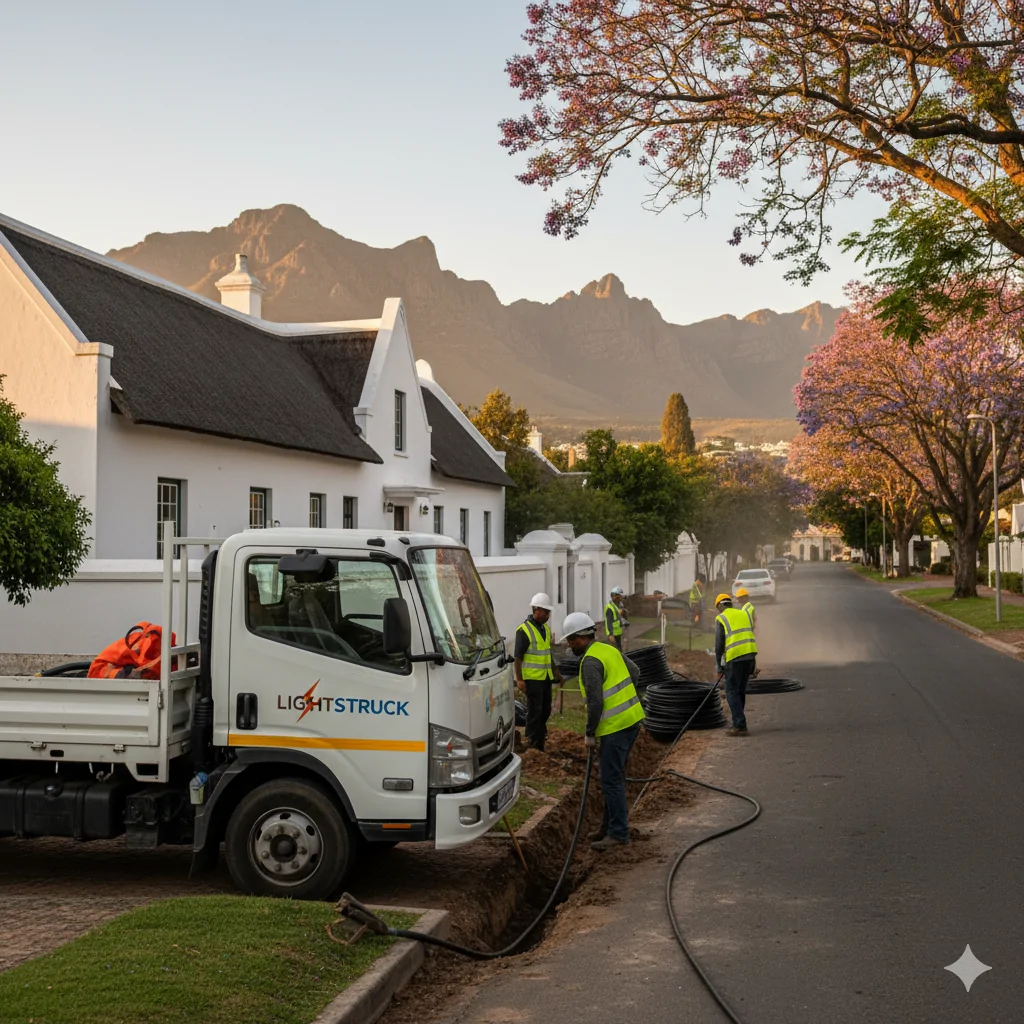
Lightstruck SA:
- Company Focus: Premium fibre service provider specializing in community-focused deployments across Southern Africa
- Market Position: Emerging player with significant growth trajectory, particularly targeting smaller towns and underserved communities
- Business Model: Develops, owns, and operates open-access fibre networks with a strategic infrastructure investment methodology
- Establishment: Installing fibre for neighbourhoods since 2016
- Geographic Expansion: Active in both South Africa and expanding into Namibia, with a projected reach of approximately 40,000 households in Namibia upon completion
- Ownership Structure: Backed by Eaglestone, a global infrastructure leader with over 100 years of experience
- Service Approach: Takes a community-involved approach by establishing local presence and appointing local fibre experts to manage operations
- ISP Partnership Model: Collaborates with reputable Internet Service Providers across the country rather than providing internet services directly
- Recent Growth: Experiencing significant expansion in 2024 through strategic acquisitions, including South Coast Fibre and a majority stake in Thinkspeed (formerly Century City Connect)
- Investment Backing: Received strategic investment from the Namibia Infrastructure Development and Investment Fund (NIDIF) for regional expansion
Lightstruck distinguishes itself from larger operators through its community-centric approach, focusing on areas often overlooked by major fibre providers while maintaining high service standards and local engagement. The company operates under an open-access model, enabling multiple ISPs to offer services through its infrastructure, which promotes competition and consumer choice.

Technological Trends and Future Developments
Advanced Fibre Technologies
The industry is rapidly adopting next-generation technologies, with F5.5G (Fifth Generation Fixed Networks) emerging as a key focus area. The Africa Broadband Forum 2024 emphasised the importance of F5.5G in accelerating all-optical connectivity across the continent, with discussions centred on policy frameworks, technological innovation, and industry best practices.
5G Integration and Mobile Backhaul
The deployment of 5G networks across Africa is creating substantial demand for fibre backhaul infrastructure. South Africa leads this development, with 41% of the population having access to 5G by September 2023. The synergy between fibre and 5G technologies is expected to drive significant infrastructure investments, with Mobile Telecommunication Network (MTN) planning to connect 10 million households by 2025, focusing primarily on South Africa and Nigeria.
Manufacturing and Local Capacity
South Africa is strengthening its position in fibre manufacturing with significant investments in local production capabilities. The recent R160 million expansion of the Yangtze Optics Africa Cable facility in Durban represents Africa’s largest optical fibre cable manufacturing plant, spanning 14,000 square meters. This development positions South Africa as a key supplier of optical fibre cable across Africa while reducing dependence on imports.
Market Projections and Future Outlook
Growth Trajectory
The African structured cabling market, which includes fibre infrastructure, is expected to reach USD 0.81 billion in 2025 and grow at a CAGR of 8.32% to reach USD 1.21 billion by 2030. This growth is driven by increasing demand for high-speed internet access, digital transformation initiatives, and the expansion of 5G networks.
Fibre and FWA Adoption
Fibre and Fixed Wireless Access (FWA) subscriptions in Africa are projected to experience remarkable growth, with increases of 245% and 81% respectively between 2022 and 2028. In 2022, Africa recorded significant increases in fibre adoption, with subscriptions growing by 43% year-over-year to reach 4.7 million.
Investment and Infrastructure Development
Major technology companies are making substantial commitments to African fibre infrastructure. Google’s $1 billion commitment in 2022 to drive Africa’s digital transformation includes significant investments in undersea cables and terrestrial fibre networks. The Umoja project, named after the Swahili word for unity, aims to create Africa’s first direct fibre-optic connection to Australia, running through multiple African countries, including Kenya, Uganda, Rwanda, DRC, Zambia, Zimbabwe, and South Africa.